"I miss shots I know I should make, and everybody at the table sees it."

Good pool players aren't gifted. They repeat a few habits.
Stroke, aim, cue ball control and planning the next ball, drawn on table diagrams, with 42 one-page drills that turn each habit into yours.
$37, one-time. One 79-page PDF to keep: read it on your phone, print the pages you need and use it on any 7, 8 or 9 foot table.
Instant access
- One PDF, 79 pages, US Letter
- Plain words and top-view table diagrams
- Works on any 7, 8 or 9 foot table
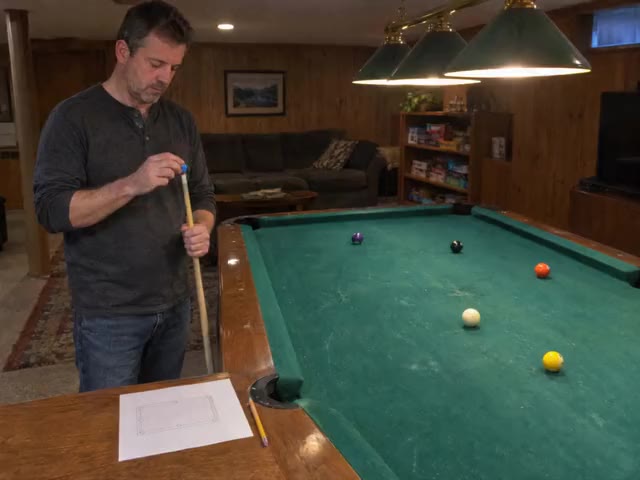
- 6 skills in a set order
- 42 drills, one page each
- 4-week plan, 20 sessions
- Score boxes to track your own game
Sound familiar?
"I make one ball and leave myself nothing on the next one."
"I scratch on shots that should be routine."
"When the game is on the line, I hurry and come up off the shot."
"The guys who beat me don't hit harder. They just never seem to be in trouble."
"I've watched hours of pool videos. At the table I can't remember any of it."
None of that is a lack of talent. Players who look like naturals do a short list of things the same way on almost every shot: a still stance and a straight stroke, one aiming method, a cue ball that goes where they meant it to, a plan for the next ball and a routine they never skip. Most self-taught players were never shown these habits in order, one at a time, at a real table. That is what this book does. It names each habit, draws it on a table diagram and gives you a drill to practice until it is automatic.
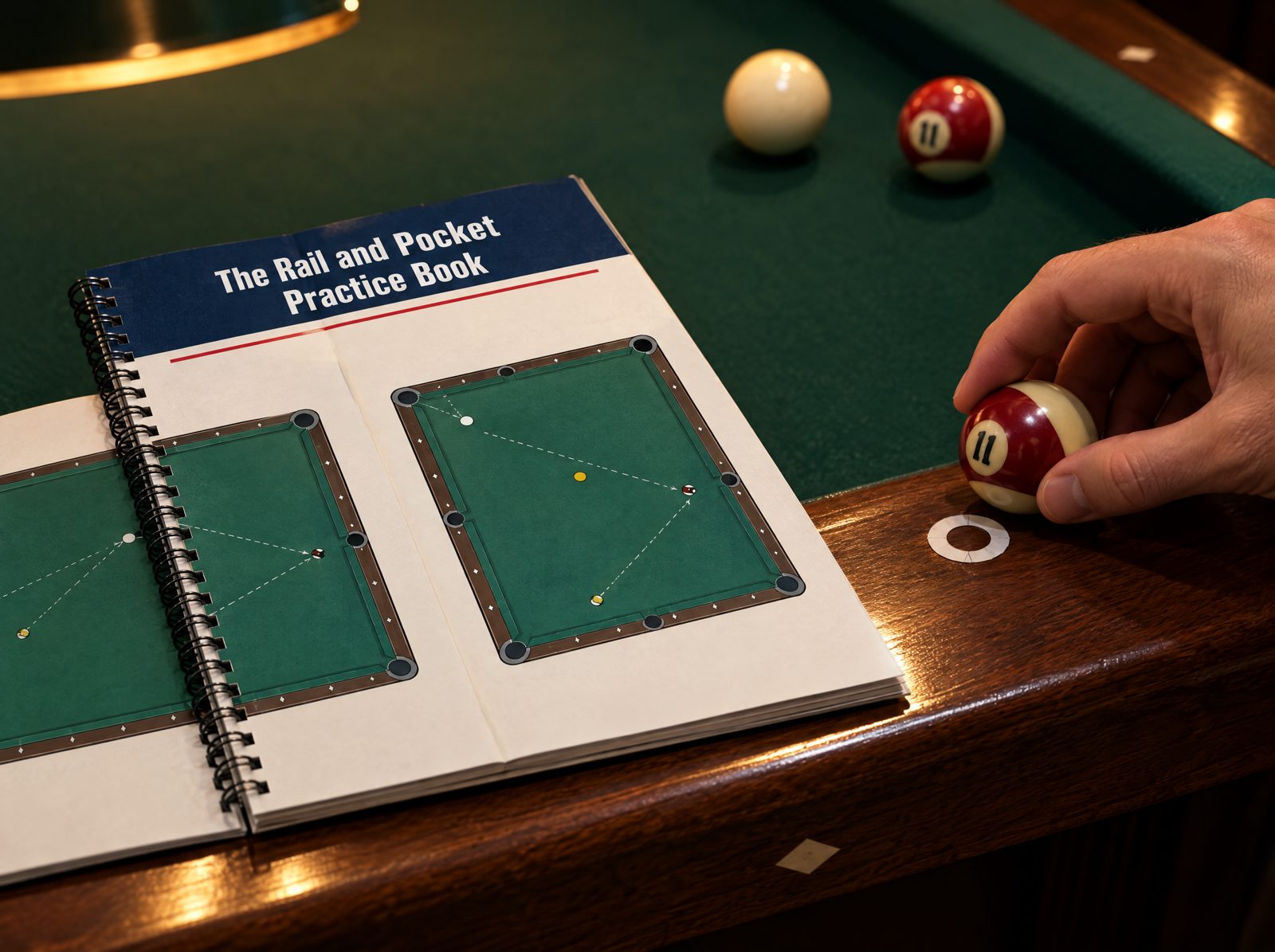
Why the same misses keep coming back
Picture a normal night at the table. You rack, break and shoot whatever looks open. You make a few, miss the long cut you always miss, leave yourself straight in behind another ball, take a guess and lose the game to someone who never seemed to be in a hurry. You go home thinking you just had an off night.
Now do the simple math. If you play three nights a week for forty minutes, that is two hours every week and more than a hundred hours a year. If none of that time goes to the habit behind the miss, a hundred hours can go by with the same miss still in your game. If even half of those nights go to one habit at a time, set up the same way and counted, the same hours start working on the thing that is actually costing you games.
What good players do that rarely gets explained
- 1
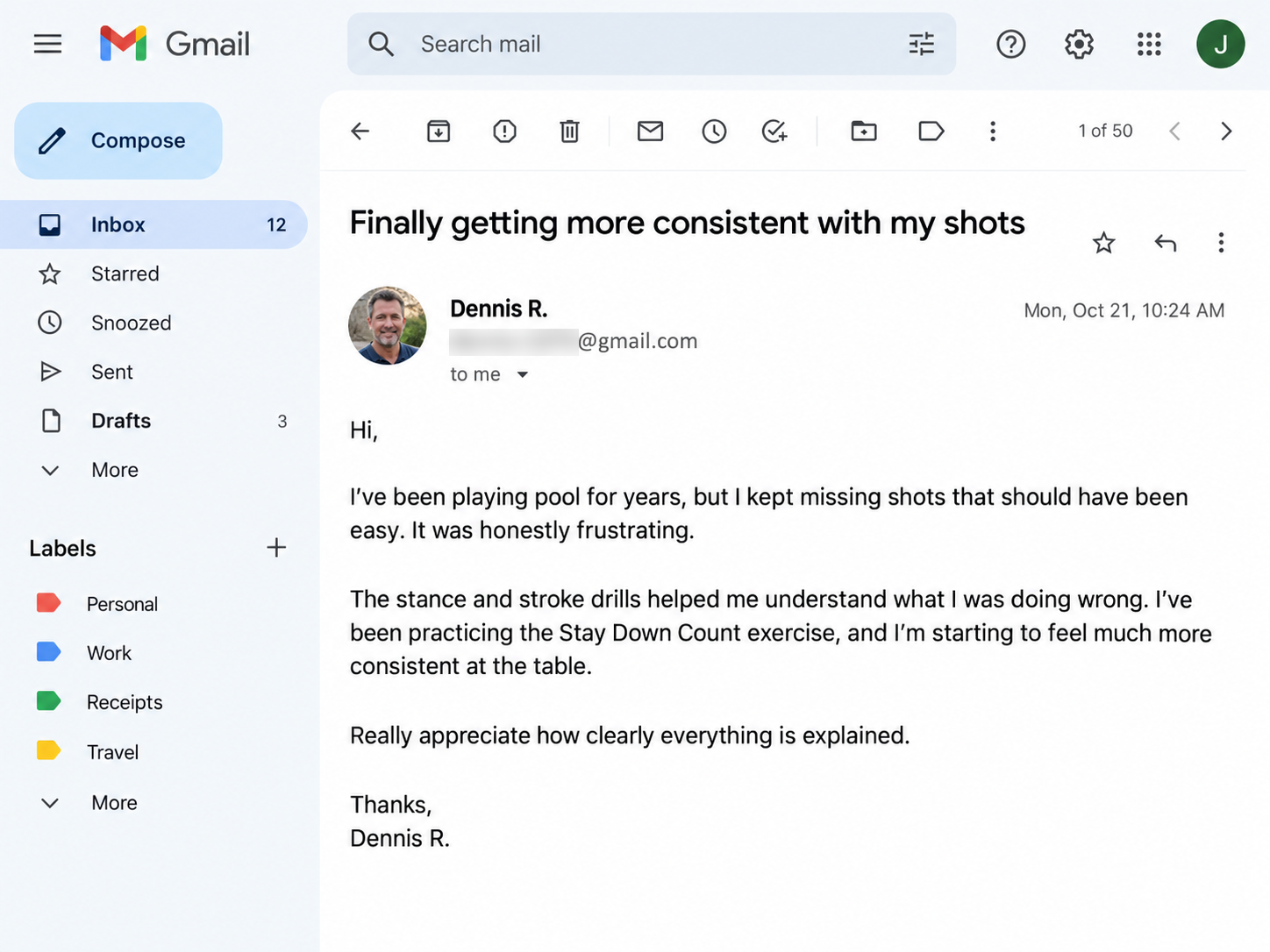
A stroke that goes where you aim. Many misses start before the cue tip touches the ball: a moving head, a rushed backswing, a jab instead of a follow-through. Part 2 has 8 drills, from Up and Back to Stay Down Count, that check your stroke with a number instead of a feeling.
- 2
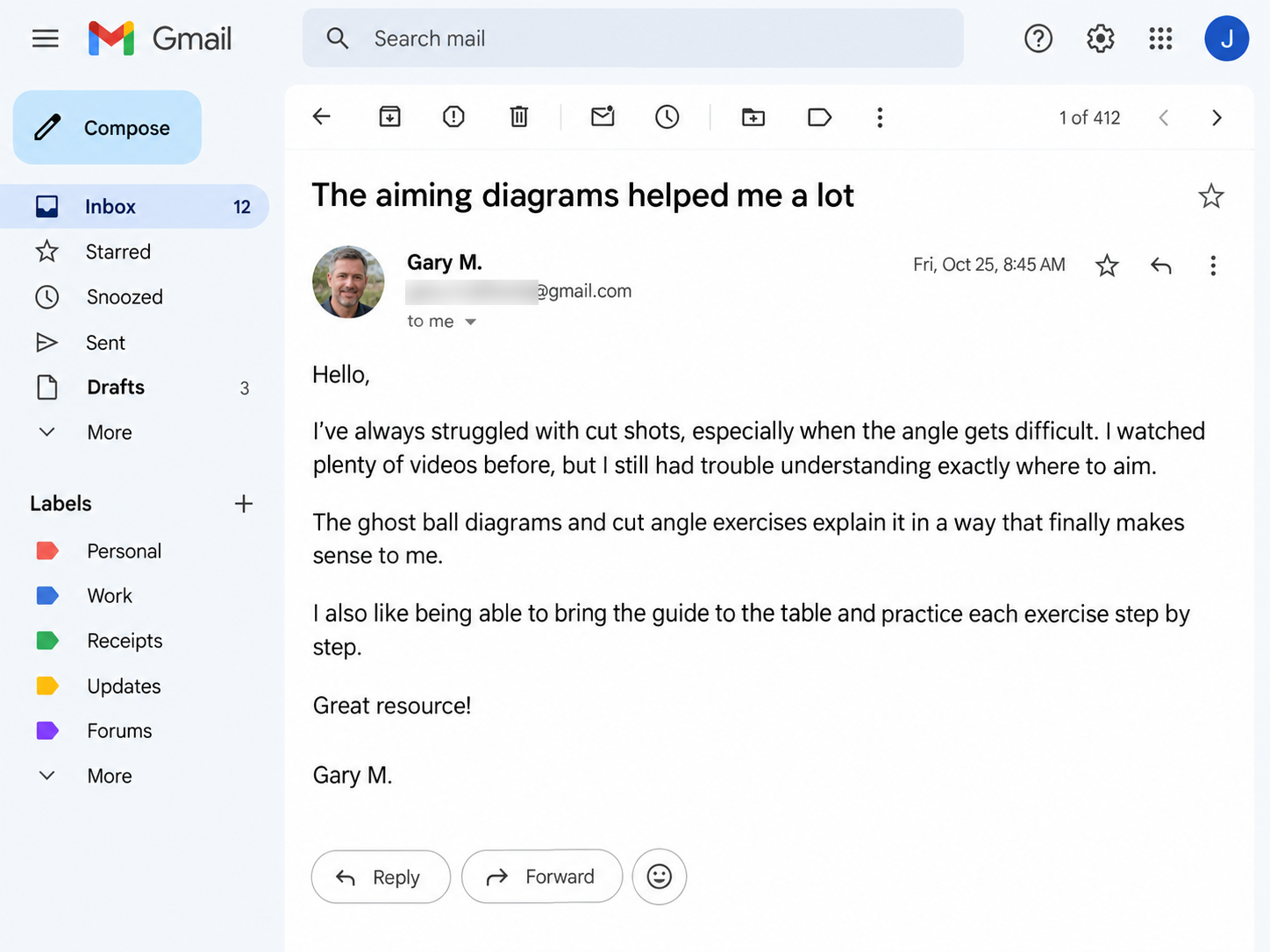
One aiming method, used every time. Ghost ball aim, cut angles to both sides, long cuts from the kitchen. Part 3 has 8 drills so you aim the same way on every ball instead of guessing.
- 3
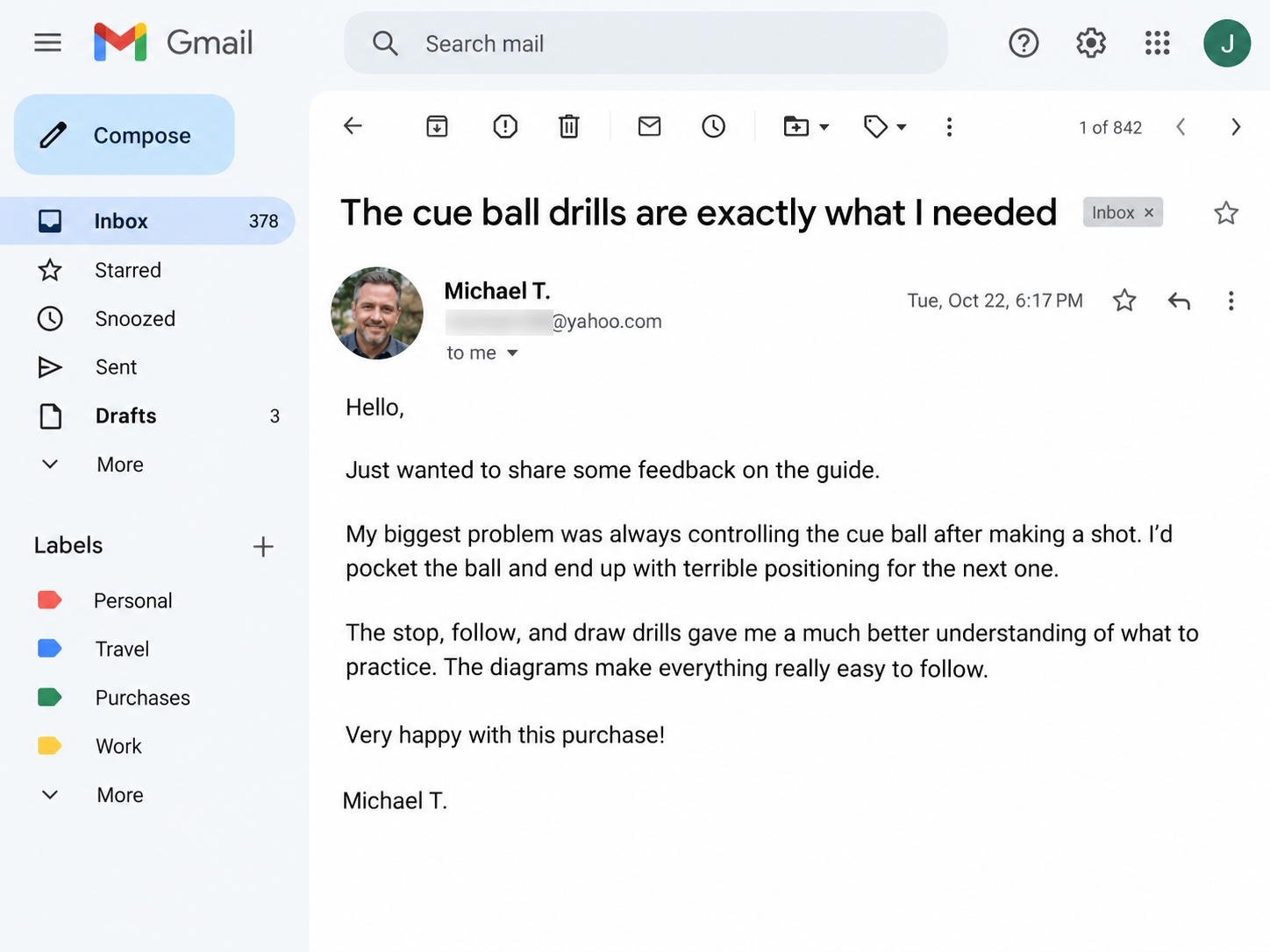
Knowing where the cue ball goes after contact. Stop, follow, draw, and the two directions the cue ball takes after a cut (the 90 and 30 degree rules from published ball physics). Part 4 has 8 drills.
- 4
Playing the next ball, not only this one. Two-ball and three-ball patterns, side to corner, a mini rotation and planning a run on paper before you shoot. Part 5 has 8 drills.
- 5
A smart answer when there is no good shot. The lag, hiding behind a blocker, thin cut and long rail safeties and a one-rail kick. Part 6 has 6 drills.
- 6
A routine you use on every shot, including the last one. One pre-shot routine, break habits and a race against the ghost. Part 7 has 4 drills and a cut-out routine card for your cue case.
How it works
- 1
Start with the habit. Read Part 1 once: the table map with diamond coordinates and pocket letters, and the scoring rules. Then open the part you are working on. Each drill page names its goal and gives you a tip.
- 2
Set up from the diagram. Find the positions on the rail diamonds, stick a paper ring where each ball goes and put the balls on the rings. About a minute per drill.
- 3
Shoot, count and write it down. Follow the numbered steps, shoot the number of tries on the page and write your score in the box with the date.
- 4
Move on when it holds. Reach the pass mark, then try the harder version or the next drill. The Weekly Review shows what went up and what to work on next.
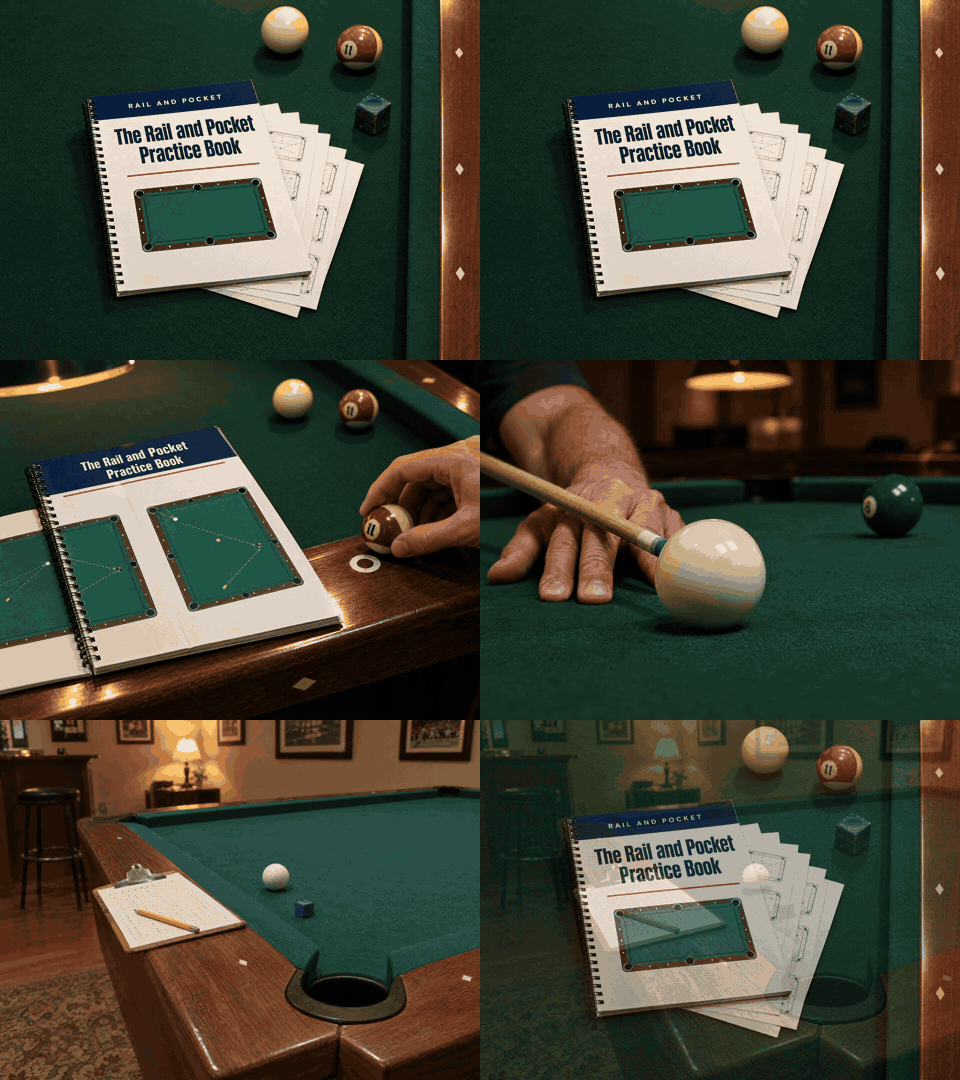
What's inside, in detail
Your download is one PDF of 79 pages, US Letter, with a cover and a full contents list. Six skills in order, then the plans and sheets that keep you on track. Here is every part, with page numbers.
The six skills (Parts 1 to 7, pages 4 to 59)
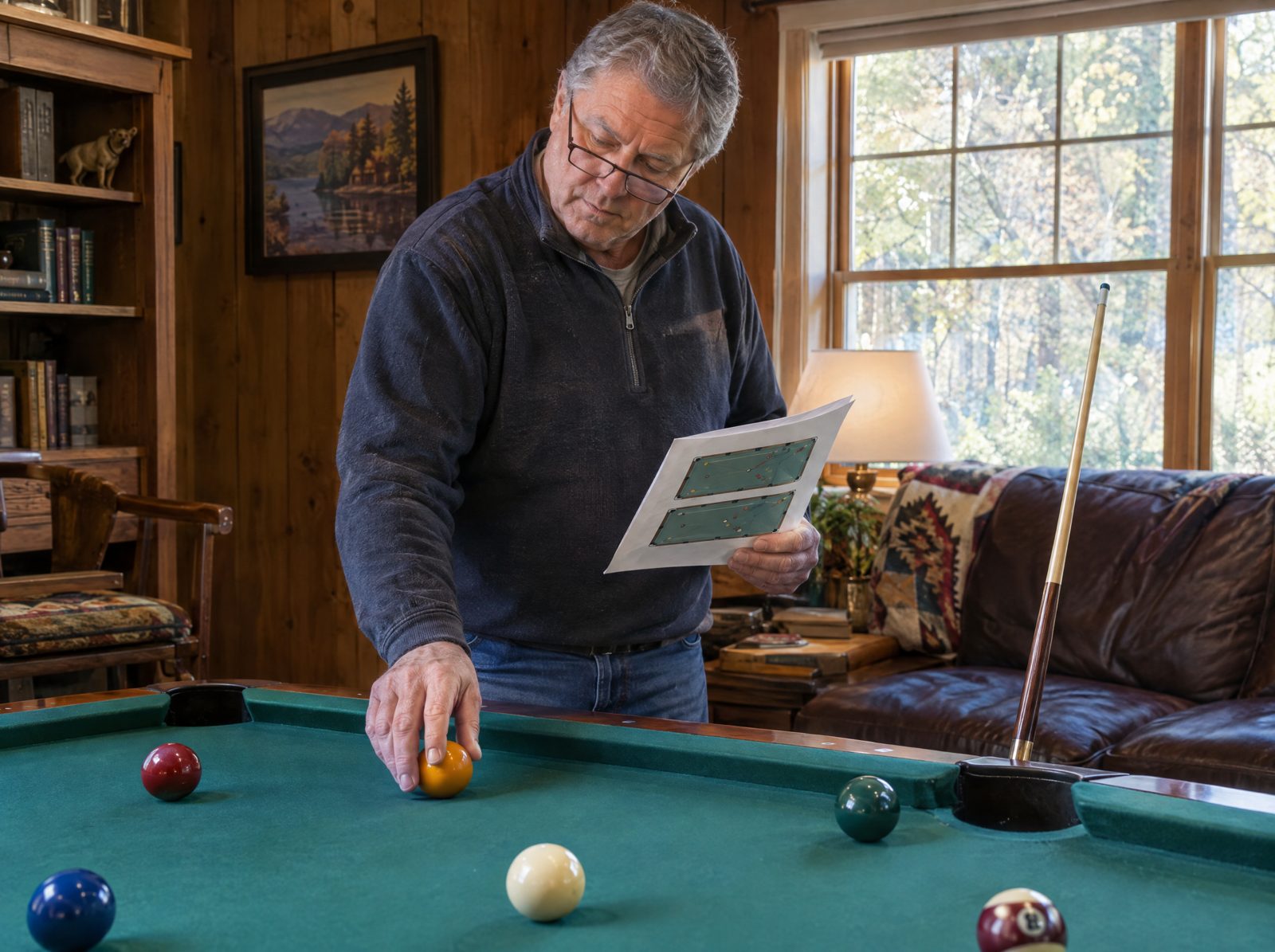
Every drill page has the same layout: a goal, a top-view diagram of a 2 to 1 table with diamonds and all six pockets, the setup in diamond coordinates, numbered steps, the pass mark, the score, an easier and a harder version, a tip and six date and score boxes.
- Part 1: Start Here (pages 4 to 10): How to Use This Book, The Table Map (coordinates, pocket letters A to F, head string, foot string, long string and spots) and Setting Up and Scoring, with honest scoring rules and table and room safety.
- Part 2: Stance, Bridge and Stroke (pages 11 to 19), 8 drills: Up and Back, Over the Spots, Three Bridge Lengths, Pause at the Back, Short Straight-In, Long Straight-In, Stay Down Count and Lag Ladder.
- Part 3: Aim and Pocketing (pages 20 to 28), 8 drills: Ghost Ball Aim, Thirty Both Ways, Cut Angle Ladder, Side Pocket Cut, Frozen Rail Ball, Long Cut from the Kitchen, Pocket Circle and Foot Spot from Five Places.
- Part 4: Cue Ball Control (pages 29 to 37), 8 drills: Stop Shot Ladder, Follow to the Ring, Draw Back to the Ring, Stun Along the Tangent (the 90 degree rule), Rolling Cut Direction (the 30 degree rule), Two Targets One Shot, Spin Off the Rail and Three Zones One Ball.
- Part 5: Position and Patterns (pages 38 to 46), 8 drills: Two-Ball Position, Three-Ball Pattern, Side to Corner, Up and Down the Table, The Foot String Line, Mini Rotation, Plan on Paper and Eight-Ball Finish.
- Part 6: Safeties and Defense (pages 47 to 53), 6 drills: Lag to the Head Rail, Hide Behind a Blocker, Thin Cut Safety, Long Rail Safety, One-Rail Kick and Pot or Hide.
- Part 7: Break and Match Habits (pages 54 to 59), 4 drills: Break and Keep the Cue Ball, Break Spot Test, Routine on Every Shot and Race to Three with the Ghost, plus a cut-out pre-shot routine card for your cue case.
All 42 diagrams were drawn for this book to a true 2 to 1 table, with the 18 sights and the pocket letters on every page, so a position like (6.5, 1.5) means the same spot on every table.
Plans, sheets and logs (Parts 8 and 9, pages 60 to 79)
The part that turns the six skills into a routine, and the sheets that keep the record.
- Part 8: Practice Plans (pages 60 to 63): the 4-week plan with 5 sessions a week of about 45 minutes (20 sessions, each listing its drills in order), session templates for 30, 45 and 60 minutes, a 15-minute league night warm-up and the Weekly Review questions.
- Part 9: Score Sheets and Logs (pages 64 to 78): 14 printable pages: the Drill Score Log for all 42 drills (3 pages), the Session Log (4 pages), the Weekly Review Sheet, the Skills Checklist with 30 milestones (2 pages) and 4 Blank Table Sheets for your own drills and layouts.
- Sources (page 79): the equipment specifications, rules terms and ball physics references the book follows, with links.
Every drill page answers the same five questions: where do the balls go, what do I shoot, how many times, what counts as a pass, and what do I try next if it is too easy or too hard.
One night with the book
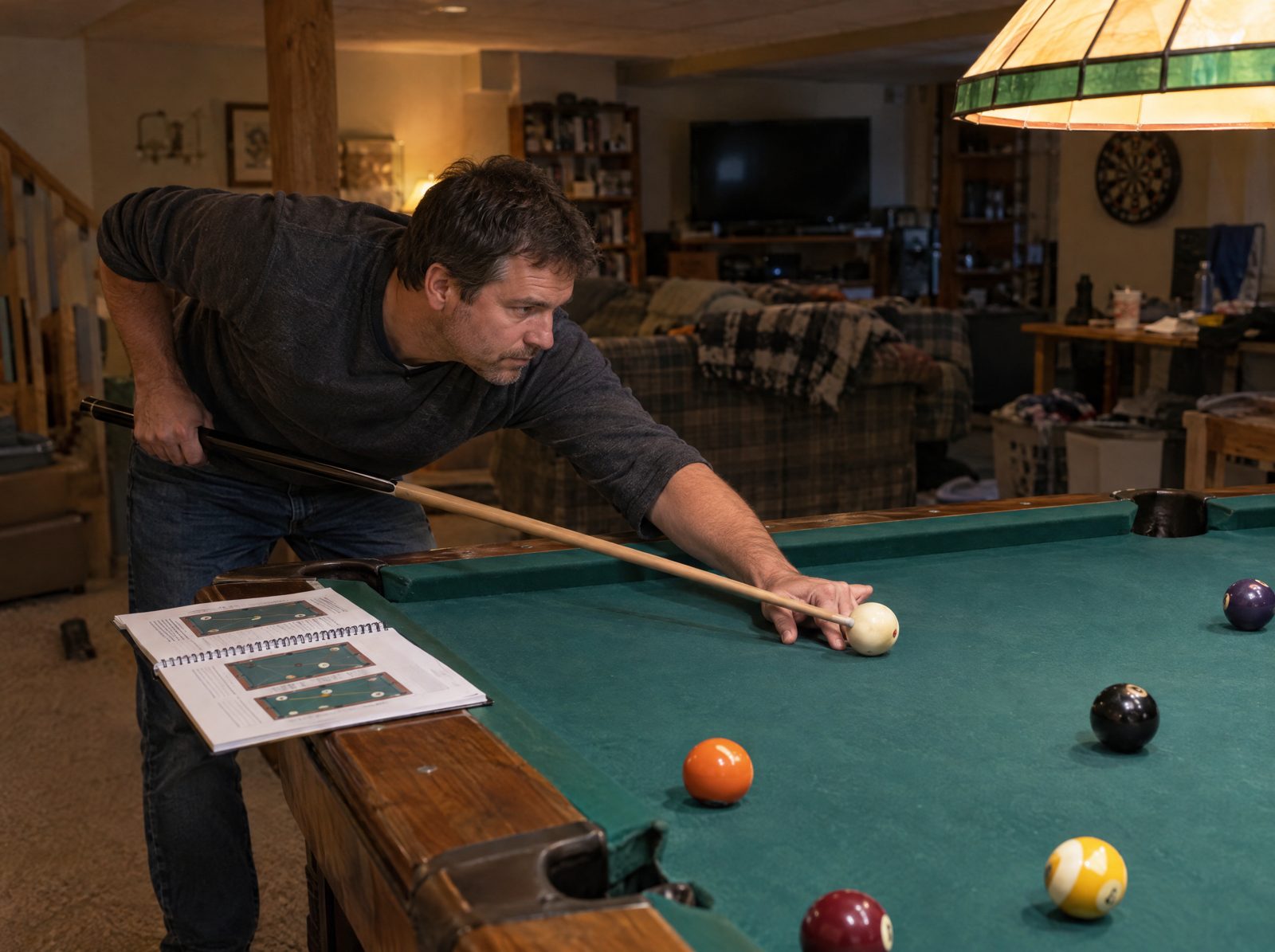
It is Thursday. Last week you lost two games the same way: you made the ball and the cue ball stopped right behind another one. So tonight is not "just shoot". You print three pages: 4.4 Stun Along the Tangent, 5.1 Two-Ball Position and 7.3 Routine on Every Shot.
Stun Along the Tangent first. You put the balls on the paper rings where the diagram shows them and play a stun shot into the cut. The page tells you where the cue ball should travel after contact, about 90 degrees away from the object ball's path, and you watch it do exactly that. Six of ten land where the page says. You write 6 in the box.
Then Two-Ball Position: make the first ball and leave the cue ball where the second one is easy. You miss the position more often than the pot, which tells you something you did not know an hour ago. You finish under the pass mark, so next time you will use the easier version printed at the bottom of the page.
Last, Routine on Every Shot. The same steps before every ball, read off the cut-out card from your cue case, through one full rack. You notice you skip the routine every time a shot looks easy.
Forty five minutes, one line in the session log: "Stun follows the tangent. I skip my routine on easy balls." Next time you are at the table, you know what you are looking at when the cue ball heads off after contact.
This book is for you if:
- You taught yourself to play and want the fundamentals spelled out in order
- You miss shots you should make or leave yourself in bad spots and want to know why
- You play at home, on bar box tables, at a pool hall or in a weekly league
- You have 30 to 60 minutes at a table a few times a week
- You like clear diagrams and printed pages more than long videos
This book is not for you if:
- You want a promise of more wins or a higher skill level by a date (nobody can honestly give one)
- You are looking for the official rule book of a specific league
- You want jump, masse or trick shot training
- You want video lessons rather than printable pages
- You want betting or gambling strategy
Three ways to learn what good players do
Knowing what to fix
Six skills in order, one habit per page
Alone: Guesswork after each miss · Videos: Whatever the last video covered
Seeing it on a table
Top-view diagram with diamond coordinates
Alone: From memory · Videos: Paused screenshots
Using it at the table
One printed page per drill
Alone: Nothing to hold · Videos: A phone propped on the rail
Knowing if it stuck
Pass mark, score box and logs
Alone: A feeling · Videos: No record
Adjusting difficulty
Easier and harder version on every drill
Alone: Guesswork · Videos: Rarely shown
What to do tonight
The next session in the 4-week plan
Alone: You decide each time · Videos: Whatever you watched last
Cost
$37, one-time
Alone: Your time · Videos: Free, plus your time
Learn the habits. Then make them yours.
6 skills, 42 drills on table diagrams, a 4-week plan and score sheets. One printable book.
Everything you get
- The six skills in order: stroke, aim, cue ball control, position, safeties and the break, each explained on its own pages.
- 42 one-page drills, each with a table diagram, setup, steps, pass mark, score, easier and harder versions and score boxes.
- The 4-week practice plan: 20 sessions of about 45 minutes, with the drills for each session in order.
- Session templates for 30, 45 and 60 minutes and a 15-minute league night warm-up.
- 14 printable score sheets and logs: drill score log, session logs, weekly review, a 30-milestone skills checklist and blank table sheets.
- A pre-shot routine card to cut out and keep in your cue case.
- Format: one 79-page PDF. Read on any device or print at home on US Letter paper.
Today: $37, one-time
Pay with card, Apple Pay or Google Pay. Secure checkout by Stripe.
14-day money-back guarantee
The Rail and Pocket Practice Book comes with a 14-day money-back guarantee. If it is not right for you, email productadvice.info@gmail.com within 14 days of purchase with the email you used to order. We will refund you in full to your original payment method. No forms and no hoops.
How we made it
Rail and Pocket follows a few editorial rules, and the book was written to them.
- Measurements from the equipment standard. Table proportions, playing surfaces (100 by 50 inches for a 9 foot table, 92 by 46 for an 8 foot), the 18 sights and their spacing come from the World Pool-Billiard Association's Recommended Equipment Specifications.
- Rules terms from a published rule book. The head string, foot string, long string, spots and the general break and foul ideas follow the World Pool-Billiard Association Rules of Play. Where a drill touches a rule, the book reminds you that your own league's rule book decides.
- Ball physics from published research. The stun and rolling directions after a cut (the 90 and 30 degree rules) follow the explanations published by Dr. Dave Alciatore of Colorado State University.
- Diagrams drawn for this book. All 42 drill diagrams were drawn to scale for this book, with exact coordinates you can set up and repeat.
- No made-up proof. There are no testimonials, no invented player stories and no promised results. The proof is in your own score boxes.
- Sources listed in the file. The book ends with a Sources page with links. These organizations are cited as sources of facts only. None of them is a partner of, or endorses, Rail and Pocket.
Scope and safety note
FAQ
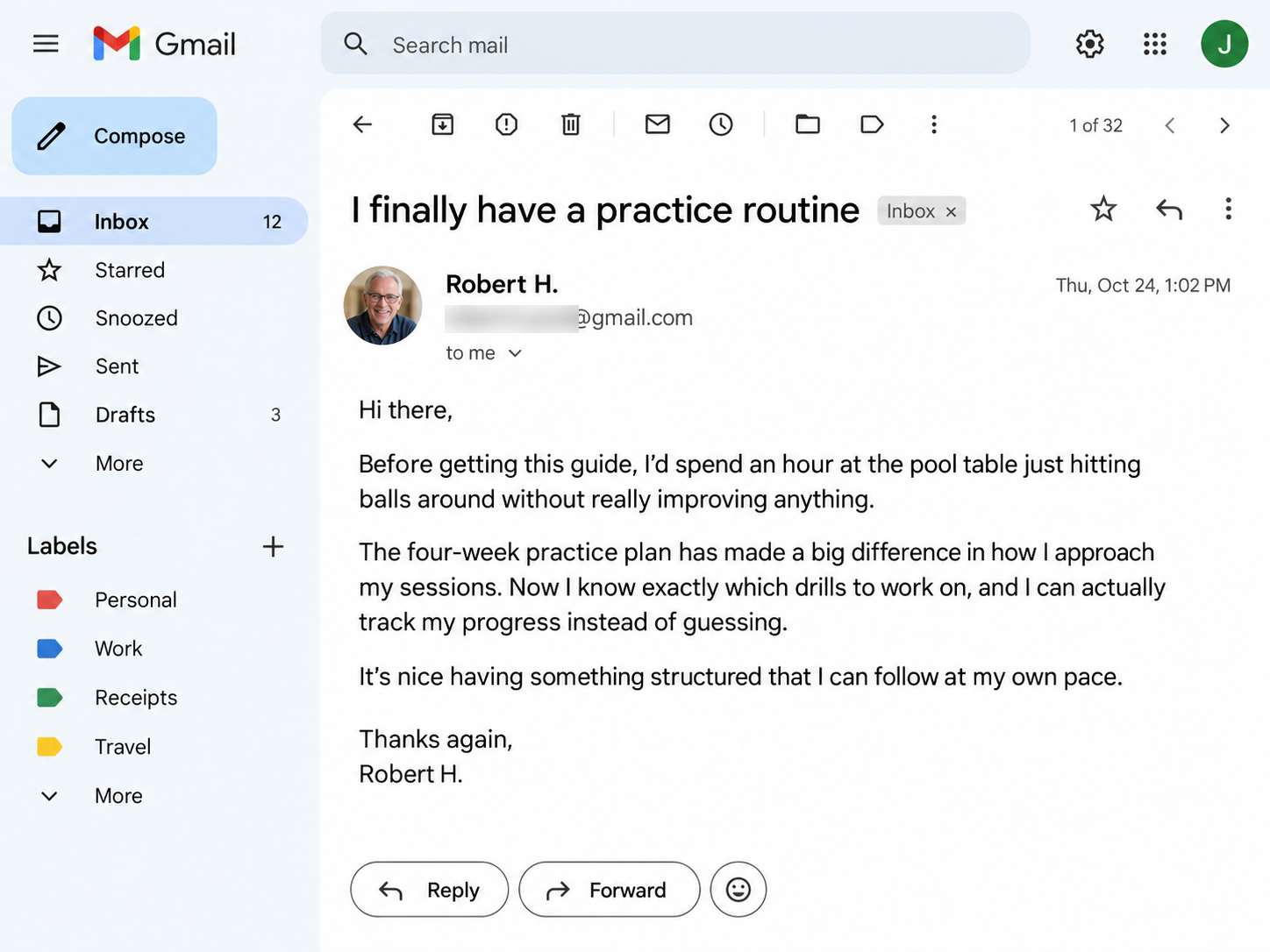
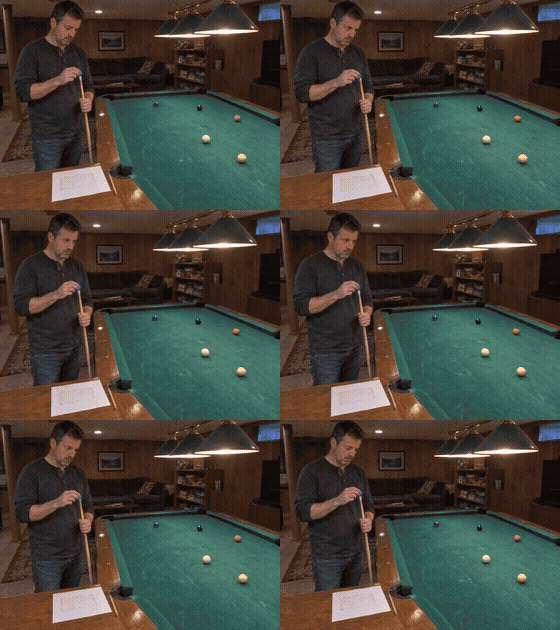
Real players, real practice
Emails from players using the practice book, shown as they arrived.
Stop guessing why you missed
Pick one habit, set it up from the diagram and put a number in the box. Forty five minutes tonight.